










Work in Germany: What a Ukrainian Needs to Know About Their Rights

Holders of temporary protection under §24 do not need a separate work permit — access to the labour market is open immediately together with the status. Employment rights — minimum wage, working time, leave, sick pay and protection against dismissal — apply to Ukrainians in the same way as to any employee in Germany, regardless of nationality.
International Law Firm ZAHIST advises Ukrainians on employment disputes in Germany — from unlawful dismissal to unpaid wages. In our practice, most violations occur precisely because the employee does not know the basic time limits: three weeks to challenge a dismissal, six weeks of paid sick leave, and clear limits on working time. A missed deadline most often means the right is lost permanently, whereas timely action usually resolves the situation in the employee’s favour.
We explain whether a work permit is required, what to look for in an employment contract, how long the Probezeit lasts, what the minimum wage is in 2026, rights to leave and sick pay, the dismissal procedure, and what to do after a Kündigung.
Is a separate work permit required
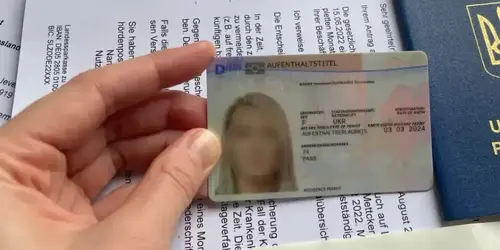
For holders of §24 status, a separate work permit (Arbeitserlaubnis) is not required — access to the labour market is open from the moment the residence permit is obtained, without any additional application to the employment agency.
This significantly distinguishes Ukrainians from applicants for ordinary asylum, whose access to work opens gradually and often with a delay. The employer must not demand a separate permit — a document confirming §24 status is sufficient.
What to look for before signing an Arbeitsvertrag
The employment contract (Arbeitsvertrag) is not always concluded in writing, but the Act on Proof of Essential Employment Conditions (Nachweisgesetz) requires the employer to record the key terms in writing no later than on the first working day.
- Position, duties and place of work
- Amount of remuneration, payment intervals, and supplements
- Duration of the Probezeit and the conditions for dismissal during that period
- Working time — number of hours per week, and the schedule
- Duration of annual leave
- Notice periods for dismissal (Kündigungsfrist)
- Reference to a collective agreement (Tarifvertrag), if one applies
The contract should be read carefully before signing — oral promises that did not make it into the written text will be much harder to prove later. If there are doubts about the wording, it is better to obtain a translation or advice than to sign a document whose content is not fully understood.
Probezeit — probationary period
Probezeit usually lasts up to six months — this is the maximum period during which a shortened notice period for dismissal applies.
During the probationary period, the notice period for dismissal is only two weeks, unless a longer period is set out in the contract. At the same time, the employee’s basic rights — minimum wage, limits on working time, paid sick leave, and annual leave — apply in the same way as after the Probezeit ends.
Wages and the minimum wage
| Parameter | Value for 2026 |
| Statutory minimum hourly wage | EUR 13.90 gross per hour |
| Planned increase from 1 January 2027 | EUR 14.60 gross per hour |
The minimum wage applies to all employees in Germany regardless of nationality or the employer’s country of origin — the only exceptions are certain narrow categories defined by law.
Payment “in an envelope” without it being shown on the payslip is a violation that deprives the employee of an official employment record, pension contributions, and proof of income for other official procedures.
Working time and overtime
The standard length of a working day is eight hours, with the possibility of extension to ten hours provided that, on average over six months or 24 weeks, the daily workload does not exceed eight hours.
- A break of at least 30 minutes for a shift lasting more than 6 hours
- A break of at least 45 minutes for a shift lasting more than 9 hours
- Uninterrupted rest of at least 11 hours between shifts
- A maximum of 48 hours per week under a six-day schedule
Overtime is work beyond the volume set out in the employment contract, whereas exceeding the statutory limit itself (8 hours per day) is regulated separately and is compensated by time off or additional pay by agreement of the parties.
Leave
The statutory minimum leave is 24 working days per year for a six-day working week, which in practice corresponds to 20 days under a standard five-day schedule.
The full entitlement to leave arises after a six-month waiting period (Wartezeit) from the start of the employment relationship. Before that period ends, the employee is entitled to 1/12 of the annual leave for each month worked.
Sick leave and sick pay
Lohnfortzahlung — continued payment of wages during illness — arises after four weeks of uninterrupted work for the same employer and lasts for up to six weeks for a single illness.
If the illness occurs in the first four weeks of employment, the employer does not continue to pay wages for that period — in that case, the benefit is paid by the health insurance fund in the form of Krankengeld, not by the employer.
After the six weeks of Lohnfortzahlung are exhausted, payment is likewise taken over by the health insurance fund, and the amount of the benefit is a percentage of previous earnings, not the full wage.
Dismissal and Kündigung
Kündigung may be ordinary — with observance of the notice period — or summary (fristlose Kündigung) — without notice, only where there is a serious ground that the employer must prove.
The notice period depends on length of service and increases as the employee’s length of service with the company increases — the longer the employee has worked, the longer the period the employer must observe in the case of ordinary dismissal.
Dismissal must be in writing — an oral notice, or one sent only via a messenger, has no legal effect.
What to do after receiving a Kündigung
On receiving a notice of dismissal, one should not delay, but immediately assess whether the ground is lawful and, if necessary, seek advice — delay is most costly precisely here, because of the strict time limit for a challenge.
- Keep the notice of dismissal itself, with the date of receipt
- Check compliance with the notice period and the correctness of the form
- Consult a lawyer or a trade union to assess the lawfulness of the dismissal
- If necessary, file a claim with the labour court within the prescribed time limit
- Register as a jobseeker with the Agentur für Arbeit in order to preserve benefits
Time limits for going to court
Kündigungsschutzklage — a claim for a declaration that the dismissal is invalid — must be filed with the labour court within three weeks of the day the notice of dismissal is received.
Missing this time limit means that the dismissal is deemed valid even where it was socially unjustified or formally defective — most grounds for challenge lose their effect once the three weeks have expired.
A claim may be filed in the labour court of first instance even without a lawyer, since mandatory representation is not required there, although advice substantially increases the chances of success.
What to do if the employer does not pay wages
The first step is a written demand (Mahnung) with a clear payment deadline, which records the fact of the debt and warns of further legal steps.
If the demand has not helped, the next step is a claim for recovery of the debt (Lohnklage) before the labour court; the limitation period for such claims is usually limited, so delay is not advisable.
In the event of the employer’s insolvency, a separate procedure applies — Insolvenzgeld, compensation from the Federal Employment Agency for the last three months of work before the insolvency proceedings are opened. This benefit must be claimed within two months after the proceedings are opened.
Arbeitszeugnis — the right to a job reference
Every employee who leaves a position — regardless of the reason and the length of employment — is entitled to a written reference (Arbeitszeugnis) from the employer.
By default, a simple reference (einfaches Zeugnis) is issued, stating the position and the period of employment; a qualified version (qualifiziertes Zeugnis), assessing the quality of work and conduct, must be expressly requested.
Work and social benefits
Income from work and social benefits are not always mutually exclusive — if wages do not cover the subsistence minimum, a top-up from the Jobcenter may be received (so-called Aufstockendes Bürgergeld).
Any income from work must be reported to the Jobcenter in good time — concealing income is treated as a violation and as grounds for repayment of overpaid amounts, and in some cases for other consequences as well.
The most common violations of foreign workers’ rights
Payment “in an envelope” without official registration is one of the most common violations, depriving the employee of pensionable service and proof of income.
- A requirement to work beyond the agreed hours without compensation
- Refusal to provide a written employment contract or confirmation of the terms of employment
- Pressure to sign an Aufhebungsvertrag (termination agreement) instead of a formal dismissal
- Non-payment or delay of wages without explanation
- Refusal to issue an Arbeitszeugnis after termination of employment
- Threats of deportation or loss of status as a means of pressuring the employee
The last point is especially dangerous for Ukrainians with §24 status — such threats have no legal basis, since the right to work does not depend on a separate employer’s permit or the employer’s goodwill.
Legal assistance with employment matters in Germany
Assessing the lawfulness of a dismissal, filing a claim in time, or securing payment of outstanding wages are tasks in which strict deadlines mean that delay costs a lost right.
The lawyers of International Law Firm "Zahist" advise on employment rights in Germany, help assess a Kündigung and prepare a Kündigungsschutzklage within the three-week period, and also assist with the recovery of unpaid wages.
We also help review the terms of an employment contract before it is signed and advise on how work interacts with social benefits.
If you have problems with an employer in Germany or need an employment contract reviewed, contact International Law Firm "Zahist" — we will examine your situation in a consultation.