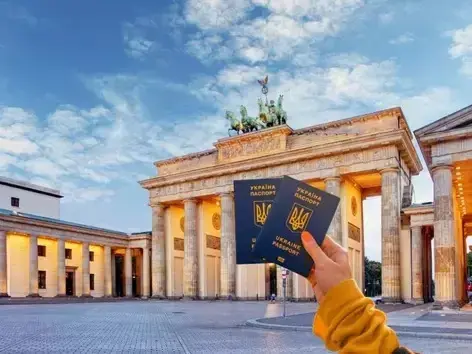











§24 or another Aufenthaltstitel: what a Ukrainian should choose in Germany
The status of temporary protection under §24 has been automatically extended until 4 March 2027, but it does not in itself lead to a permanent residence permit (Niederlassungserlaubnis). To lay the groundwork for a permanent status, it is advisable to assess in good time a switch to a targeted Aufenthaltstitel — through employment, a Blue Card, university studies or Ausbildung — without leaving Germany.
International Law Firm "Zahist" advises Ukrainians on a strategy for remaining in Germany for years ahead. In our practice, most clients delay switching to another status while §24 is still in force, and then find that far less time remains for gathering documents and confirming qualifications than initially seemed to be the case.
We examine what §24 provides today, until when it remains in force, which alternatives exist — from skilled employment and the Blue Card to university studies and Ausbildung — and whether it is possible to switch to another status without leaving Germany.
What the §24 status provides today and until when it remains in force
Status under §24 AufenthG grants access to the labour market, education, housing and social benefits — practically the same scope of rights as a full residence permit, but of a fundamentally different nature.
As of February 2026, permits valid on that date have been automatically extended until 4 March 2027 without the need to file a separate application with the foreigners’ authority.
It is important to understand the legal nature of this status: it was created as an instrument of temporary protection, not as an independent basis for subsequent permanent residence in the country. Therefore, time spent under §24 is, as a general rule, not converted directly into qualifying residence for a Niederlassungserlaubnis.
Why it is worth considering alternatives to §24 in advance
A switch to another status is possible with virtually no restrictions — provided that the applicant meets the requirements of the specific Aufenthaltstitel to which they wish to switch.
The key practical condition is that such a change must take place while the permit under §24 is still valid or while confirmation of the filing of an application (Fiktionsbescheinigung) remains in effect. Postponing this decision until the last moment significantly reduces the time available to prepare documents.
- Skilled employment — §18a or §18b AufenthG for qualified specialists
- EU Blue Card — for academic professionals with a high level of income
- Ausbildung — vocational training with subsequent employment
- University studies — §16b AufenthG
- Family grounds — reunification with a family member who holds another status
Aufenthaltstitel through skilled employment
Sections §18a and §18b AufenthG cover qualified specialists with vocational training and with academic education, respectively. Since November 2023, where the conditions are met, the authority is obliged to issue the permit, rather than merely being able to do so — this changes the applicant’s position from that of a petitioner to that of a person with a legal right to obtain the title.
Another significant change is that the link to the qualification obtained has been abolished: a qualified specialist may now work in any skilled position, not only in one corresponding to their diploma.
For academic education, recognition is carried out through the Anabin database or an assessment by the ZAB, and for a vocational diploma — through the chamber of industry and commerce or the chamber of crafts.
EU Blue Card — conditions for 2026
| Parameter | Condition for 2026 |
| Minimum salary, general occupations | EUR 50,700 per year |
| Minimum salary, shortage occupations (IT, engineering, medicine) | EUR 45,934.20 per year |
| Education | Recognised higher-education diploma |
| Contract | At least 6 months |
The EU Blue Card is aimed specifically at specialists with higher education and a concrete job offer at the corresponding income level. Graduates and qualified IT specialists without a higher-education diploma may obtain the card at the lower income threshold if the occupation is a shortage occupation.
In addition to access to employment, the EU Blue Card also offers a further advantage — a shorter route to a permanent residence permit compared with the standard titles for employed persons.
Status for qualified specialists without higher education
Not only holders of diplomas have a route to a lawful status through employment — recognised vocational education under §18a opens the same possibility for specialists in skilled trades and technical occupations.
The condition for recognition of a vocational qualification is confirmation that the education obtained in Ukraine is equivalent to the German standard, which is established through a recognition procedure before the relevant chamber or competent authority.
Ausbildung — vocational training as a route to status
A permit under §16a AufenthG is issued specifically for vocational or school-based training and for further qualification.
- A training place recognised by the competent authority
- Sufficient living space
- Independent means of securing the subsistence minimum for the period of training
A switch to this route is possible even before the procedure for obtaining a title under §24 has been completed, if departure to the country of origin in order to obtain a visa is currently impossible because of martial law. After training is completed, there is a prospect of switching to §18a as a qualified specialist.
University studies as an alternative to §24
A permit under §16b AufenthG is intended for admission to a university or for preparatory courses prior to studies, and likewise requires proof of independent means of securing the subsistence minimum.
The advantage of this route is that it combines education with a future prospect of switching to the status of a qualified specialist immediately after studies are completed, without having to look for work from scratch while holding §24 status.
Family grounds as an alternative route
Reunification with a family member — a husband, wife or the parents of a child — who already holds another status in Germany not connected with §24 may also serve as a basis for a switch.
This route makes sense above all where a family member is already working in a skilled occupation or studying on the basis of a separate title, rather than under §24 itself. In that case, the switch takes place under the rules of ordinary Familiennachzug, not under the simplified temporary-protection procedure.
Whether it is possible to switch to another Aufenthaltstitel without leaving Germany
Yes — the switch takes place directly at the foreigners’ authority at the place of residence, without returning to Ukraine to complete a visa procedure.
There are virtually no restrictions on such a change — the main condition is that the applicant meets the requirements of the new, targeted title at the time the application to switch is filed.
While the application for the new title is being examined, and the permit under §24 is still valid or confirmation of filing remains in effect, the person retains the right of residence and access to the labour market without interruption.
Requirements as to employment, income, education and language under different titles
| Title | Key requirement |
| §18a / §18b — qualified specialist | Recognised education + corresponding employment |
| EU Blue Card | Higher-education diploma + salary from EUR 45,934 to EUR 50,700 per year |
| §16a — Ausbildung | Training place + secured subsistence minimum |
| §16b — university studies | Enrolment + secured subsistence minimum |
Language requirements are not uniform for all titles — for skilled employment, the level required for the specific position is most often sufficient. By contrast, university studies or Ausbildung may require separate proof of German or, in some programmes, English.
Advantages and limitations of the different options
There is no universal status that is equally advantageous for everyone — the choice depends on existing qualifications, current income and readiness to study or to obtain fresh recognition of a diploma.
Working in one’s profession yields the fastest and most stable result for those whose education has already been recognized, whereas Ausbildung or studies require more time but suit those whose qualifications do not yet have direct confirmation in Germany.
The EU Blue Card is attractive because of its high income and an accelerated path to permanent status, but it is available only to those who already have a specific job offer with the required salary — not a basic or mid-level income.
Which documents to start preparing in advance
- Education diploma with a translation and, where required, an apostille
- Confirmation of qualification recognition through Anabin, ZAB, or the relevant professional chamber
- Employment contract or a preliminary job offer stating the salary
- Certificate of sufficient living space
- Proof of language proficiency, if required by the chosen title
Collecting and legalizing documents should begin well before the §24 permit expires, because recognition of a diploma or confirmation of a qualification by a chamber may take several months on its own, without counting the time needed for the application for a new title.
What to consider for those who want to stay in Germany long term
The long-term outlook is built not on the mere fact of holding §24 status, but on a consistent transition to a title that counts toward the period required for a permanent residence permit.
The earlier the transition to the target title takes place, the sooner the qualifying period required for a Niederlassungserlaubnis begins to run — and postponing this decision until the final year of §24 means lost time that cannot be recovered.
Typical mistakes when transitioning from §24 to another status
The most common mistake is filing an application for a new title only after the §24 permit has expired, when confirmation of filing (Fiktionsbescheinigung) has not been issued in time.
The second typical situation is that the applicant starts the procedure for recognition of a diploma or professional qualification too late, failing to take into account that review by a chamber or ZAB may take several months and proceeds separately from the application for the title.
The third mistake is relying solely on the first job option offered without comparing it with alternatives such as the Blue Card or studies, even though comparing several paths often yields a substantially better long-term outlook.
Legal assistance with a change of status in Germany
Assessing which Aufenthaltstitel matches your qualifications and situation, and preparing the documents before §24 expires, is a task where timely advice saves months.
Lawyers at International Law Firm "Zahist" help identify the optimal path from §24 to employment, the Blue Card, studies, or Ausbildung, and assist with filing the application at the foreigners’ authority.
We also advise on the recognition of Ukrainian diplomas and qualifications and prepare documents for filing without the need to leave Germany.
If you are planning a transition from §24 to another status in Germany, contact International Law Firm "Zahist" — we will review your situation in a consultation.