









International protection in Poland: refugee status and subsidiary protection

International protection in Poland exists in two forms — refugee status and subsidiary protection. An application is submitted in person through the Border Guard, after which the case is examined within the statutory 6 months by the Head of the Office for Foreigners.
International Law Firm "Zahist" assists clients in international protection cases in Poland. In our practice, the greatest confusion arises precisely from the difference between this procedure and temporary protection for Ukrainians — these are two different mechanisms with different consequences, and the choice between them should be made consciously.
We explain which forms of protection exist, how to file an application, and what to do if recognition of status is refused.
International protection in Poland — two forms of protection
An application for international protection may result in one of two outcomes — recognition of refugee status or the grant of subsidiary protection, depending on the specific circumstances of the case.
Refugee status — when it is granted
Refugee status is recognized for a person who has a well-founded fear of persecution in the country of origin on account of race, religion, nationality, political opinion, or membership of a particular social group — according to the criteria of the Geneva Convention.
This is the highest level of protection with the broadest scope of rights, which is why the requirements for proving the grounds are the strictest here.
In practice, each case is assessed individually: what matters is not only the general situation in the country of origin, but also the applicant’s specific personal history, which must be set out consistently and, where possible, supported by evidence.
Subsidiary protection (ochrona uzupełniająca) — how it differs
Subsidiary protection is granted to those who do not meet the formal criteria for refugee status, but whose return to the country of origin would expose them to a real risk of serious harm — for example, due to an armed conflict.
According to statistics from recent years, subsidiary protection is granted significantly more often than refugee status — it is a more realistic, albeit somewhat narrower in terms of rights, outcome for most applicants.
For example, in the first months of 2026, subsidiary protection was granted to 461 persons, while refugee status was recognized for only 179 applicants — a telling difference as to which outcome is more often to be expected in practice.
How international protection differs from temporary protection for Ukrainians
Temporary protection for Ukrainian nationals operates under a simplified collective EU mechanism — without an individual examination of each person’s circumstances, quickly and on a mass scale.
International protection, by contrast, involves an individual procedure with a personal interview, examination of specific grounds, and a statutory time limit of up to 6 months — which in practice is often longer.
For most Ukrainians covered by temporary protection, filing a separate application for international protection makes little sense. The situation is different, however, for those who face persecution for reasons not directly related to the war, or for third-country nationals who are not covered by the collective mechanism.
How to file an application for international protection
- Apply in person to a Border Guard unit — at the border when crossing or at any office within the territory of Poland
- Undergo an interview with a Border Guard officer, with an interpreter if necessary
- Sign the application completed in Polish on the basis of the interview
- Obtain a temporary foreigner’s identity certificate confirming submission of the application
An application cannot be filed in writing by post or online — personal presence and an interview are a mandatory part of the procedure.
The application also covers the applicant’s minor children if they are travelling together — a separate standalone document does not need to be completed for each child, although data about them is also recorded during the interview.
What happens after the application is filed
Temporary foreigner’s identity certificate
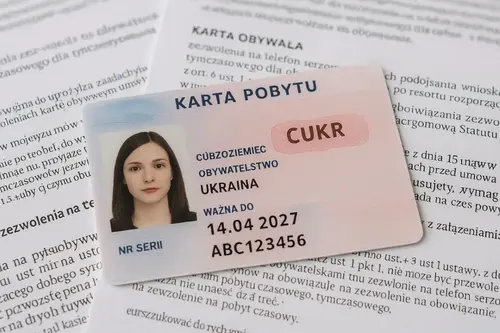
Every adult receives a temporary foreigner’s identity certificate — a document that confirms the applicant’s identity and entitles them to stay legally in Poland for the duration of the case examination.
This document is not equivalent to a residence card and does not confer the right to cross the border — its function is limited to confirming the applicant’s status within the country.
During the examination of the case, the applicant is as a rule entitled to accommodation in a specialized centre, basic material assistance, and access to medical care — the exact scope depends on the specific situation and available places.
| Form of protection | Grounds | Scope of rights |
| Refugee status | Well-founded fear of persecution | Broadest |
| Subsidiary protection | Real risk of serious harm | Somewhat narrower |
| Refusal | Grounds not established | Right of appeal |
How long the examination takes and how to appeal a refusal
The statutory time limit for examining an application is 6 months, although in practice, due to the workload of the authority, the examination often takes longer.
In more complex cases requiring additional verification of circumstances or international cooperation between authorities, the time limit may be extended — the applicant is officially notified of this and is not left without an explanation.
A refusal by the Head of the Office for Foreigners may be appealed to the Refugee Board within 14 days of receipt of the decision — or only 5 days if the refusal was based on the manifest unfoundedness of the application.
The Refugee Board is a separate body that examines such complaints; in practice, first-instance decisions are sometimes quashed, so an appeal should not be dismissed as a mere formality.
For example, in a case decided in early 2026, the Board quashed a refusal by the Head of the Office concerning a Russian national — confirming that appellate review is not a purely formal stage and genuinely affects the outcome.
If the time limit for appeal is missed, it can be restored only if there are valid reasons — therefore the date of receipt of the decision should be monitored with particular care.
Legal assistance with international protection in Poland
Properly preparing for the interview, gathering evidence of the grounds for protection, and filing an appeal in time in the event of a refusal are tasks where legal support substantially affects the outcome.
Lawyers of International Law Firm "Zahist" help determine which form of protection fits the specific situation, and assist with filing applications and appealing refusals in international protection cases.
We also advise on whether it makes sense to file an application for international protection in parallel with existing temporary protection — in most cases this is unnecessary, but there are exceptions that should be assessed individually.
If you are considering filing an application for international protection or have received a refusal you wish to appeal, contact International Law Firm "Zahist" — we will review your situation at a consultation.
It is especially important to seek advice before filing the application, not after — some decisions made at the interview stage are difficult to correct later once the case is already under examination.