









Residence card or CUKR card: what to choose when leaving temporary protection

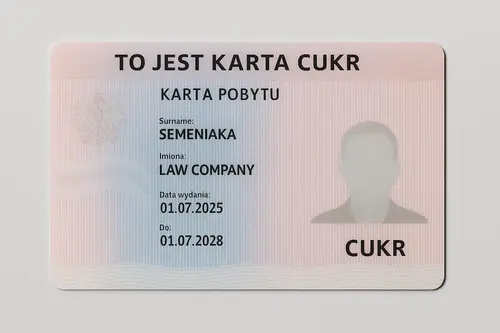
The CUKR card is not a separate type of document, but a special subtype of residence card specifically for those leaving temporary protection: it is issued without a voivode’s decision and without an income check. A “standard” residence card is issued on a specific ground — employment, business, or studies — and that is where income or turnover is verified.
International Law Firm "Zahist" advises clients who are deciding whether to move from temporary protection to a more permanent status. In our practice, confusion arises precisely because of the name — people perceive CUKR as something third and separate from a residence card, although in essence it is one of the routes to obtaining one, simply under simplified conditions.
We break down how the CUKR card differs from a residence card on a general ground, what is lost and what is retained upon transition, and when which option makes sense.
What the CUKR card really is
The CUKR card confirms the grant of a temporary residence permit on special terms — without a separate voivode’s decision, which significantly speeds up and simplifies the procedure compared with the general procedure.
It is issued exclusively to citizens of Ukraine and members of their families with a valid PESEL with UKR status — it is not a universal residence card option available to anyone, but a narrowly targeted instrument for this category only.
The card is valid for 3 years and confers the right to work without an additional work permit and without an employer notification obligation — in this respect it is similar to the rights that already applied under temporary protection.
The main practical value of CUKR lies precisely in this combination: rights close to those under temporary protection, but already in the form of a more stable status that does not depend on annual political decisions to extend the entire EU protection scheme.
Conditions for obtaining a CUKR card
To apply for a CUKR card, you must have a valid PESEL with UKR status on the date of filing and continuous UKR status for at least 365 days.
Filing is done via the MOS portal, which launched on 27 April 2026 — you must personally log in through login.gov.pl and complete the application form specifically for a residence card for Ukrainian citizens under temporary protection.
An application may be filed until 4 March 2027 — this is the final deadline after which the option to use this simplified route closes.
Costs are limited to the state fee for granting a temporary residence permit (PLN 340) and the fee for producing the card itself (PLN 100) — substantially less than the full set of costs when applying from scratch on a general ground.
The requirement of continuous UKR status for at least 365 days means that those who obtained temporary protection only recently cannot claim CUKR. For them, the only options for now remain the general-ground route or waiting until the required period of stay is accumulated.
A standard residence card — on a specific ground
A residence card on a general ground — employment, own business, studies, or family reunification — requires proof of that specific ground. This means an employment contract with an appropriate salary, a registered business with real turnover, or a certificate from an educational institution — depending on the chosen path.
Here the decision is made by the voivode individually in each case, not automatically as for CUKR — and processing times are usually substantially longer, especially in overloaded voivodeships.
The advantage of this route is flexibility: the ground can match a person’s real life plans, not only past temporary protection status, and under some grounds the path toward permanent residence is counted differently than for CUKR.
| Criterion | CUKR card | Standard residence card |
| Ground | Prior temporary protection (PESEL UKR) | Employment, business, studies, etc. |
| Income check | Not conducted | Mandatory, under specific criteria |
| Voivode’s decision | Not required | Individual decision |
| Validity period | 3 years | Usually 1–3 years depending on the ground |
| Cost | PLN 340 + 100 | Depends on the ground, usually higher |
| Application deadline | Until 4 March 2027 | Not limited |
What is lost and what is retained when switching to CUKR
Obtaining a CUKR card cancels UKR status — and with it the benefits tied specifically to that status, for example free collective accommodation in refugee centres.
At the same time, access to general programmes — 800+, family benefits, social pension, “Active Parents” — is retained, but already on the general terms that apply to all residents of Poland, not under the simplified rules for UKR status.
For 800+ this means going through the same check of professional activity and the child’s education that has applied since February 2026 also to some categories with UKR status — there is no longer a material difference on this point.
After switching to CUKR, the 30-day rule and the risk of automatic loss of status due to departure or an unconfirmed identity no longer apply — a residence card is in this sense more stable and less sensitive to technical details of the PESEL register.
When to choose CUKR and when a standard residence card
CUKR makes sense for those without stable confirmed income — business starters, freelancers with irregular earnings, or those who have not yet formalised official employment. This is where the absence of an income check becomes the decisive advantage compared with the general procedure.
A standard residence card on a specific ground is better suited to those who already have stable employment with an appropriate salary or a profitable registered business — especially if long-term plans are tied specifically to that field of activity.
Because a CUKR application may be filed only until 4 March 2027, postponing the decision until the last moment is risky — it is worth assessing your situation in advance rather than deciding in haste closer to the deadline.
An interim option is to wait before applying for CUKR while continuing to use temporary protection until clarity on stable income emerges, and to file closer to the end of the permitted period if a better option has not been identified by then.
Legal assistance with choosing a status
Comparing both routes for a specific situation and not losing access to benefits that are still needed is a task where a mistaken choice is hard to reverse after the fact.
Lawyers at "Zahist" help assess which route fits your situation and prepare documents for CUKR or for a standard residence card on a specific ground.
We also advise on which benefits are actually lost when switching to CUKR in your particular case — so that the decision is based on precise data rather than general assumptions.
If you are unsure which path to choose — a CUKR card or a residence card on another ground — contact International Law Firm "Zahist": we will analyse your situation at a consultation.