









How to Apply for Permanent Residence in Poland: Grounds and Application Procedure

Permanent residence (zezwolenie na pobyt stały) can be obtained on several different grounds. The most common are 5 years of continuous residence with refugee status or subsidiary protection, Polish origin with a Pole’s Card, or marriage to a Polish citizen for at least 3 years.
International Law Firm "Zahist" handles permanent residence cases in Poland. In our practice, most refusals occur not due to a lack of grounds, but because of choosing the wrong ground or gaps in documents confirming continuous residence.
We break down which grounds exist, how permanent residence differs from EU long-term resident status, and what changed in the application procedure from 2026.
What permanent residence is and how it differs from a temporary residence permit
A permanent residence permit is issued indefinitely — unlike a temporary residence permit, which must be regularly extended every one to three years depending on the ground.
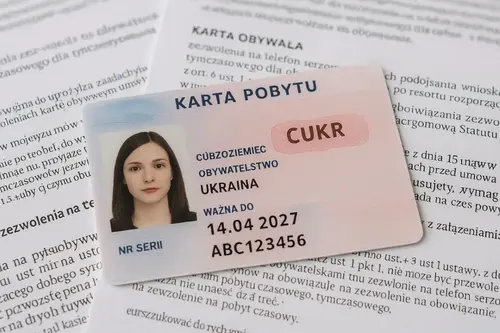
The card that physically confirms the status is issued for 10 years and must be replaced after it expires — but this is a purely technical procedure that does not affect the indefinite residence status itself.
A permanent residence holder may work in Poland without a separate work permit and without additional documents from the employer — one of the main practical advantages compared with a temporary residence permit.
Main grounds for obtaining permanent residence
The Act on Foreigners provides several independent grounds for permanent residence — they are not interchangeable, and each requires its own set of documents.
5 years of continuous residence with protection status
This ground applies to persons who have been granted refugee status, subsidiary protection, or consent to stay for humanitarian reasons — an application may be filed after 5 years of continuous residence in Poland from the date the relevant status was granted.
Residence is considered continuous if a single departure from Poland did not exceed 6 months and all departures over the entire period did not exceed 10 months in total.
Exceeding these limits does not necessarily mean an automatic refusal, but it significantly complicates the case — so days spent abroad should be counted in advance rather than reconstructed retrospectively before filing.
Polish origin and the Pole’s Card
A person of Polish origin or a holder of a valid Pole’s Card who intends to settle in Poland permanently may apply for permanent residence without a 5-year residence requirement in the country.
This ground is substantially faster than others because it does not depend on the length of prior stay — the key is to prove Polish origin or the validity of the Pole’s Card at the time of filing.
Proof of origin usually requires archival documents about ancestors — birth records, nationality certificates from pre-war or post-war registers — so collecting this package should begin well before the planned filing date.
Marriage to a Polish citizen
Marriage to a Polish citizen recognized under Polish law and lasting at least 3 years before the application is an independent ground for permanent residence.
Unlike the procedure for recognition as a citizen, this concerns a permanent right of residence rather than acquisition of citizenship — these are different statuses in substance, even though both rely on the fact of marriage.
Divorce or annulment of the marriage before filing means loss of the right to rely on this ground — the applicant must then seek another path, for example through 5 years of continuous residence if the relevant status applies.
| Ground | Minimum period | Key condition |
| Protection status (refugee, subsidiary, humanitarian) | 5 years | Continuous residence |
| Polish origin / Pole’s Card | No period requirement | Proof of origin or a valid card |
| Marriage to a Polish citizen | 3 years | Marriage recognized under Polish law |
EU long-term resident status — an alternative to permanent residence
EU long-term resident status is a separate status that also grants the right to indefinite stay, but with broader options to move to other EU countries.
To obtain it, you must confirm 5 years of legal and continuous residence in Poland, a stable source of income, and knowledge of Polish at least at B1 level.
In practice, the choice between permanent residence and EU long-term resident status depends on the applicant’s plans: if you do not intend to move to other EU countries, the simpler and usually cheaper path is permanent residence on the applicable ground.
How to file an application — documents, fees, and 2026 changes
From 27 April 2026, permanent residence applications are filed exclusively electronically via the MOS 2.0 portal — paper filing in person at the voivodeship office is no longer available for new cases.
Filing via MOS 2.0 requires a PESEL number, an account on login.gov.pl, and a Trusted Profile or a qualified electronic signature to sign the application.
From 1 September 2026, new requirements were added to the document package for permanent residence and EU long-term resident status — PIT-37 tax returns for the last 3 years, certificates of no arrears from the tax office and ZUS, and a language certificate.
- Completed electronic application via the MOS 2.0 portal
- 4 biometric photographs
- Valid travel passport
- Documents confirming the chosen ground — protection status, origin, Pole’s Card, or marriage certificate
- PIT-37 for the last 3 years and certificates of no arrears from the tax office and ZUS (from 1 September 2026)
The state fee for examining the application is PLN 640, and production of the card itself is a further PLN 100 separately; these amounts are paid at different stages of the procedure.
The application should be filed no later than the last day of legal stay — missing this moment creates a risk of losing continuity of status, even if the right to permanent residence has already arisen in substance.
Processing times and obtaining the card
A decision on granting permanent residence is generally issued within 6 months from the date a complete set of documents is filed or from the date deficiencies in the application are remedied.
This period is a benchmark set for standard cases; more complex matters requiring additional verification of the documents submitted may take longer without a formal breach of procedure.
After a positive decision, the applicant files a separate request for production of the card — it is the card that physically confirms the status and is needed for border crossing and everyday formalities, while the residence permit itself is valid indefinitely from the date of the decision.
Legal assistance with obtaining permanent residence
Identifying the fastest available ground and assembling a complete document package the first time is a task where a formal error means refiling and months of waiting lost.
Lawyers at "Zahist" help assess which ground fits a specific situation, prepare the application via MOS 2.0, and collect documents in line with the new 2026 requirements.
We also help calculate the exact date when the continuous residence or marriage period reaches the required minimum so the application can be filed as soon as the formal right arises.
If you plan to apply for permanent residence in Poland and want to choose the correct ground from the outset, contact International Law Firm "Zahist" — we will review your situation at a consultation.